
Back when I initially published my (admittedly awful) first eBook, in late 2013, I danced with visions of retiring rich. Then I released the book to crickets and got a nice, big, fat reality check. There are self-published authors who make a respectable income – a few ranging upward of $1 million a year. The typical indie author reports experiences more akin to mine.
Except…
Several months ago, I made a serendipitous friend who dragged my happy butt into a FB group called 20BooksTo50K. It was a swift kick where the sun don’t shine. To be perfectly honest, it’s one of the main reasons I’ve stuck with Facebook lately, since the platform itself has become such a political cesspool. The 20Books group is a gold mine of information about not only the writing craft in general, but how to convert into a successful business. There’s a literal blueprint available for free, including downloadable tools and forms to help you write more, faster, better. Third party tools are also debated and recommended. There are sister groups dedicated to critiquing covers and blurbs (the back-cover text), and for advertising help. At last count, we were something like 60 thousand strong just in the main group.
People share their successes (and occasional crashes and burns.)
One example of why I’m sticking like glue:
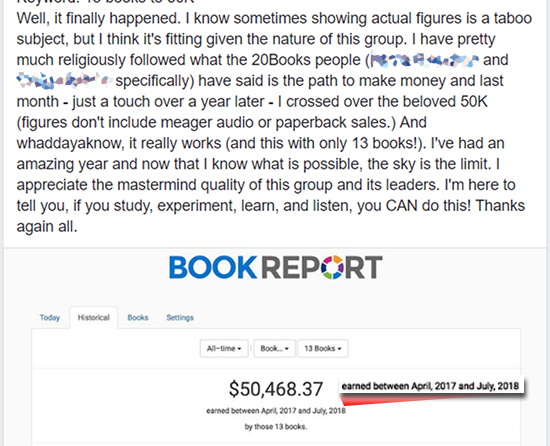
Believe it or not, this is a middle-ground report. It’s fairly common to see someone making in the hundreds or low thousands of dollars monthly. (Most folks show one month’s report, rather than a year’s income.) One person consistently tops $25K per month. The higher figures are usually traceable to the size of the author’s catalog, and the time they’ve invested in writing. Puts a whole different perspective on the phrase, “Time is money,” doesn’t it?
To be fair, these figures also don’t show the cash investments that went into the process. There are costs for advertising, editing, formatting, cover design, etc. I’m actually good for the cover design element, thank goodness, and fine with formatting my own books both for print and eBook publication. So that alone saves me a few hundred bucks, at least. Editing is huge, and if you go with audio books it’s (justifiably) astronomical to get things professionally recorded. Some of these folks have taken writing workshops and training. Hopefully one day soon I can participate in something similar.
Think about it: even allowing 20% for advertising and setup expenses, $25K a month is a hella lot of chump change. And once you’re in that echelon, you’re not paying 20% for those costs. No matter how you slice it, these are real-world people making a decent income from writing, many of them now writing full-time for a living. I wanna be them when I grow up.
Incidentally, as the above author noted, this doesn’t include print or audio book royalties. For some writers, those two contribute the bulk of their sales, adding a good chunk of cash to their wallets monthly. I personally made more from my non-promoted print book the first week than I made from my first ebook in three years. The above also doesn’t count anything sold through platforms other than Amazon – which, again, pad the income.
IF I do my own indie publishing gig, I plan on requiring my authors to at least read some of this information, which is priceless. It’s in everyone’s interests if they’re successful. Even if I don’t go the publisher route, I’m putting as much of the education as I can into daily practice.
Your writing is too good not to succeed in the market. No matter what avenue you take. And that’s not just “rah rah!” internet back-patting. Your stuff is gold.
Thank you. My stuff is at best brass – but I’m getting there 😉
However, I thought about this for you. Amazon has a script-writing page, just started. You can write and format a script online – and once done, can submit it to them, if you like. With their foray into streaming television, they’re looking for scripts they can turn into series and/or movies.
https://storywriter.amazon.com
Do it. Do it now. If I’d jumped on the Kindle bandwagon back in 2005-ish when they first started, I’d be a full time writer by now, and it’s probably one of my all-time biggest regrets I putzed around for nearly 10 years before doing anything about it.
I’m glad you have discovered some secrets to success. For myself, I don’t know how ambitious I am. Maybe I should pursue this more seriously but I just don’t have the desire at this time.
It’s not for everyone. I personally would prefer to retire and write strictly for the fun of it. But for now I’m looking into whatever option(s) makes the most sense for me.
I’m in 20booksto50k and agree it’s an incredible resource. I’m fairly new to fiction and haven’t hit big numbers yet. I think fiction authors earn more, but there are nonfiction writers doing well too. Writing to Market is one approach they promote. It’s based on the Chris Fox book. Also, rapid release is great because it takes advantage of the Amazon new release algorithms. So if you have 3 or 4 books already written, there are several people who have used the rapid release strategy successfully. I’m not often star struck bit I’ve seen some indie authors in there that I read. I like that they run a tight ship too so you don’t get a lot of self-promotion. Good luck!
I wish I could write faster. I’m doing my best to hit at least three fast-release books this year but I honestly don’t know if it’s possible. I work full time and deal with disability, and some days I’m doing good to get out of bed.
I totally understand. I write mysteries and am a slowwww writer. I thought I might continue my current series so I’m at least putting books out there. More books is the key. I thought I’d start writing a second series on the side with maybe 250 pages a book and wait until I had 3 of those before I published. I just don’t know where I’ll find the energy and time though. The other strategy you might be interested in is outsourcing. I think some of the writers pick a profitable genre, outline 3 books at a high level and then outsource the writing. The trick is finding a good writer. If I ever hit my monthly financial target, I’d seriously consider trying that.